One way
A classroom course
Every subject delivered back-to-back inside a single scheduled event.

A practical guide
L&D's biggest challenge is how to organise and control all the activities that people need to do beyond courses and content to apply learning and achieve performance improvement.
This is a practical guide on how you can extend formal training to ensure it is applied. We will see digital experiences that enable practice, exploration and the development of capability in the workplace:
Together they give you clear mechanisms to track application and measure results.
Every course flows into real workplace tasks, coaching and practice, in the flow of work, not forgotten after the event.
L&D keeps guiding and supporting learners long after the classroom closes, with the right activity at the right moment.
Evidence, peer review and manager sign-off replace attendance records, so you can show measurable performance change.
Start from the ground up
A learning workflow in this approach can be viewed as three levels: activities grouped under subjects, subjects linked into a workflow. Let’s start with the activities and see how they build up to a learning workflow.
The building block
The smallest building block is a single activity: an interactive experience.
Each activity engages the learner straight from the screen, eg booking a coaching session, uploading evidence of a real workplace task, joining a virtual classroom, or recording a role-play straight to camera.
Each activity has visual and written descriptors to clearly show the learner what and why they are doing it.
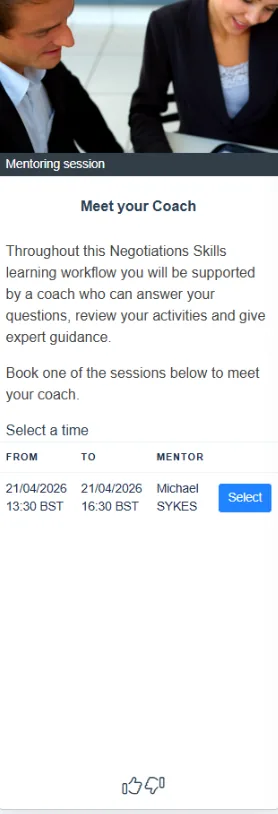
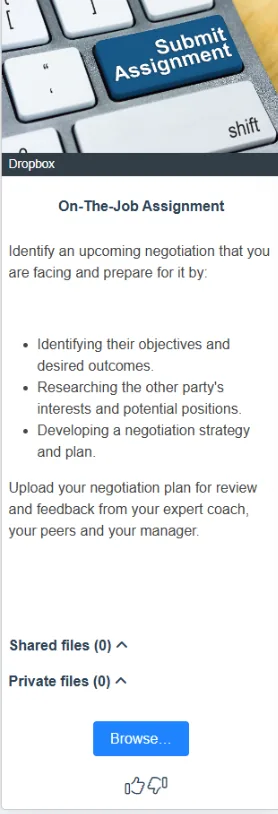
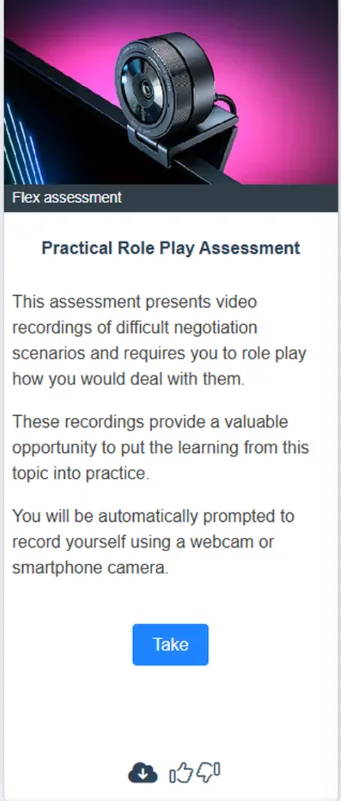
Just three of many activity types: classroom, e-learning, video, assignment, coaching, feedback, collaboration, reflection and more.
Activities, grouped
Activities can be grouped under the same subject: formal training and the performance-based activities that apply it, together in one place.
Every activity for that subject sits on a single screen, so all these activity types are in one place.
The learner sees how each activity relates to the subject and how the learning and its application combine to drive performance improvement.
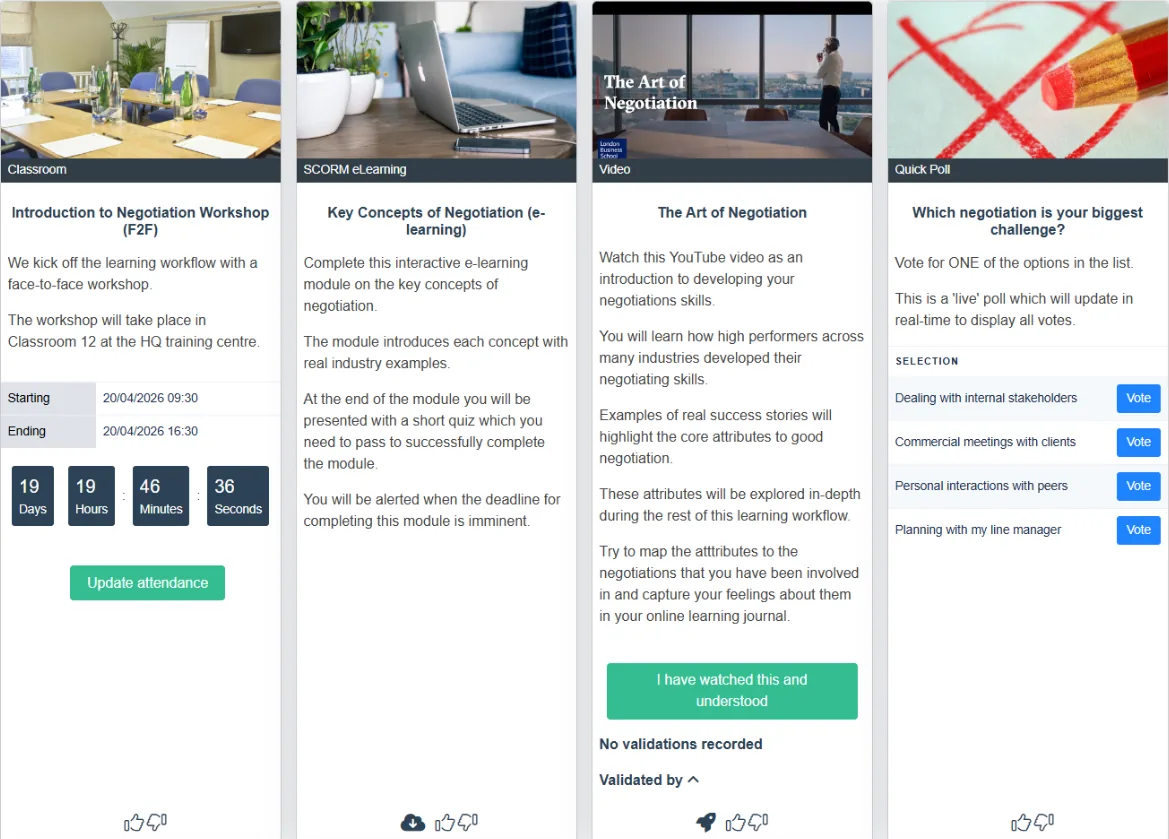
The taught content: a classroom workshop, an e-learning module, a video and a live poll.
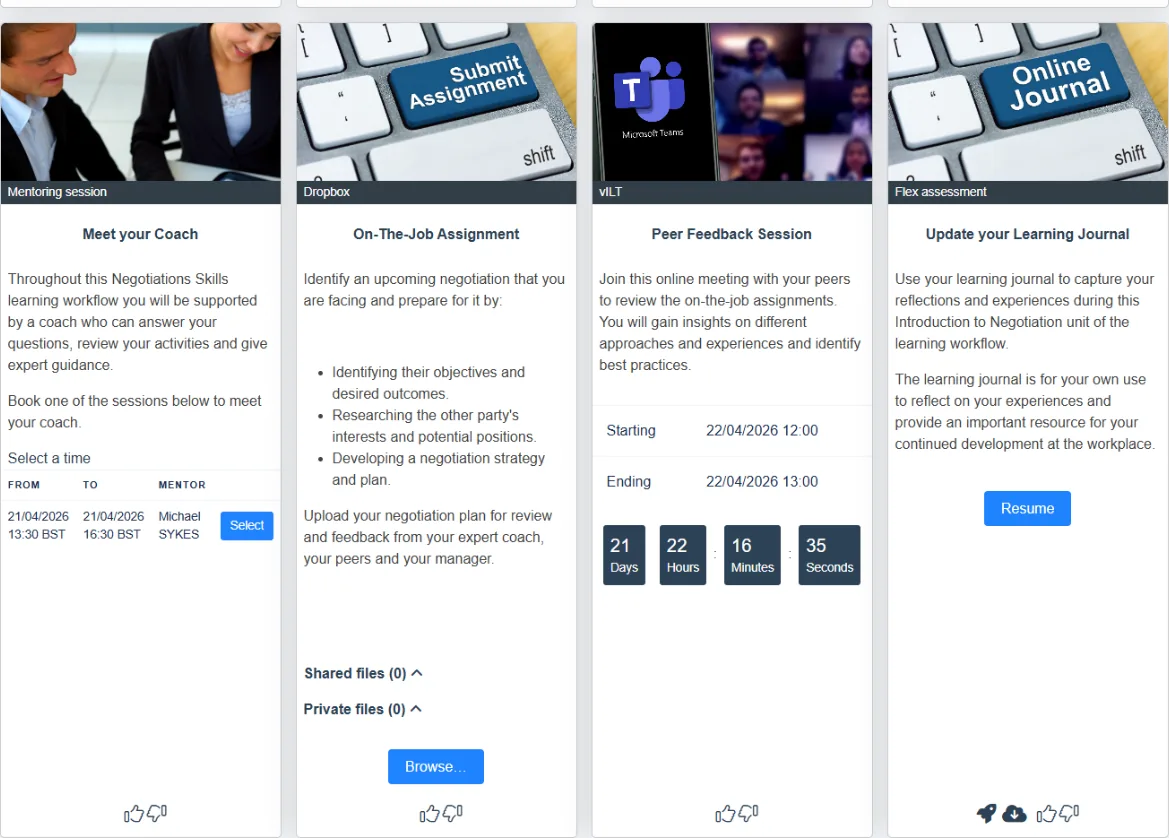
Applying it at work: coaching, an on-the-job assignment, a peer feedback session and a reflective journal.
One subject, one view: every related activity grouped together, from learning through to application.
Subjects, linked
Finally, connect this subject with the others in sequence and you have a learning workflow: a single guided path that carries the learner from the first subject to the last, with every activity organised and controlled in one place.
In this guide we have used the example of a Sales negotiation programme. The approach can be applied to any intervention: Leadership, onboarding, technical, even compliance.
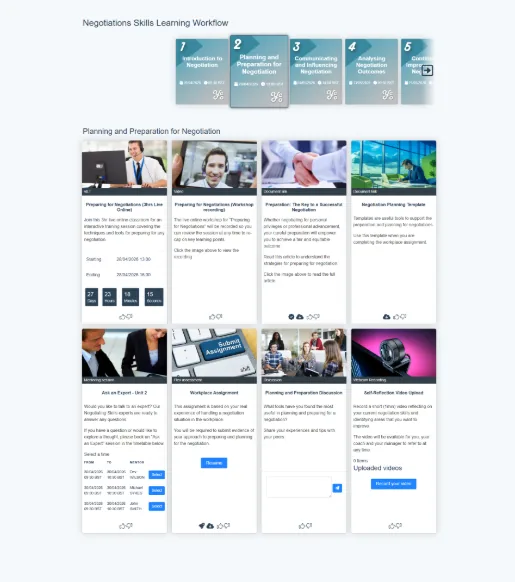
Subject 2 · Planning and Preparation
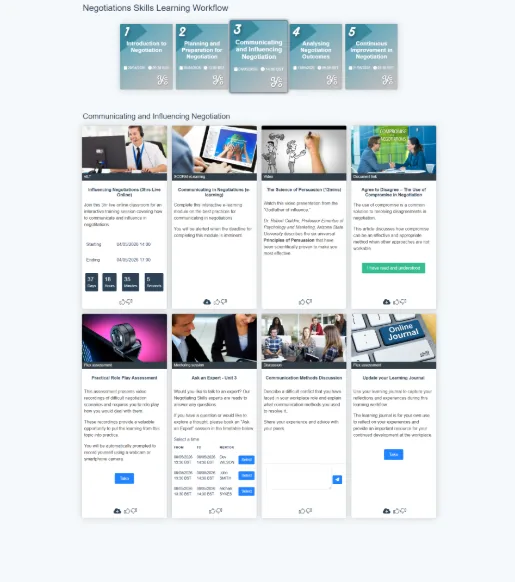
Subject 3 · Communicating and Influencing
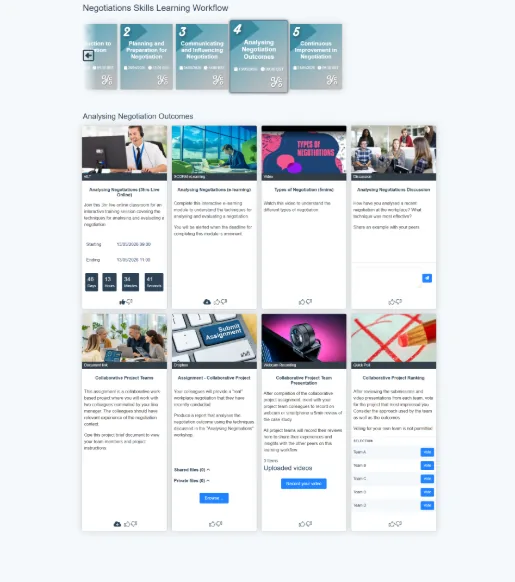
Subject 4 · Analysing Negotiation Outcomes
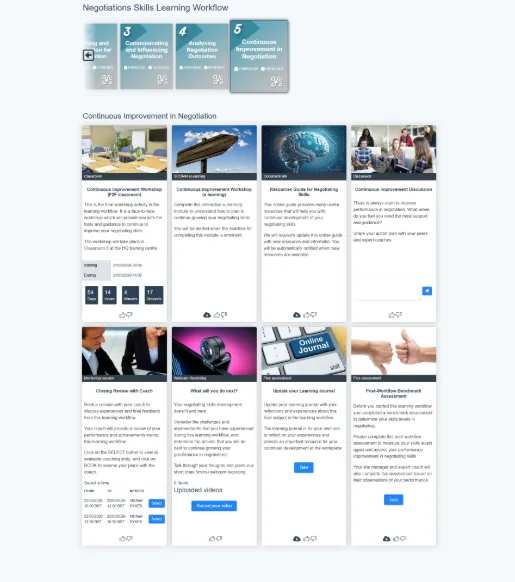
Subject 5 · Continuous Improvement
Four more subjects, each built the same way, linked into one workflow.
A familiar starting point
Take a common skills development request: build Negotiation Skills capability across the workforce. The instructional design might map several subjects to be covered:
Most organisations cover all five subjects in one of two ways.
Every subject delivered back-to-back inside a single scheduled event.
One module per subject that learners work through on their own. An approach reflected in most Learning Management Systems (LMS).
In both cases, learners go back to the workplace once the subjects have been covered. There's no guided pathway to organise and support the activities that follow, and no opportunity to apply the learning where it actually matters.
A better way
There's a better way. Instead of ending when the course is completed, L&D stays in contact with learners, not with more courses, but by guiding them to the activities that apply learning in the flow of work.
We call these performance-based activities. The vLearning Platform organises them alongside formal training into one continuous sequence: a learning workflow.
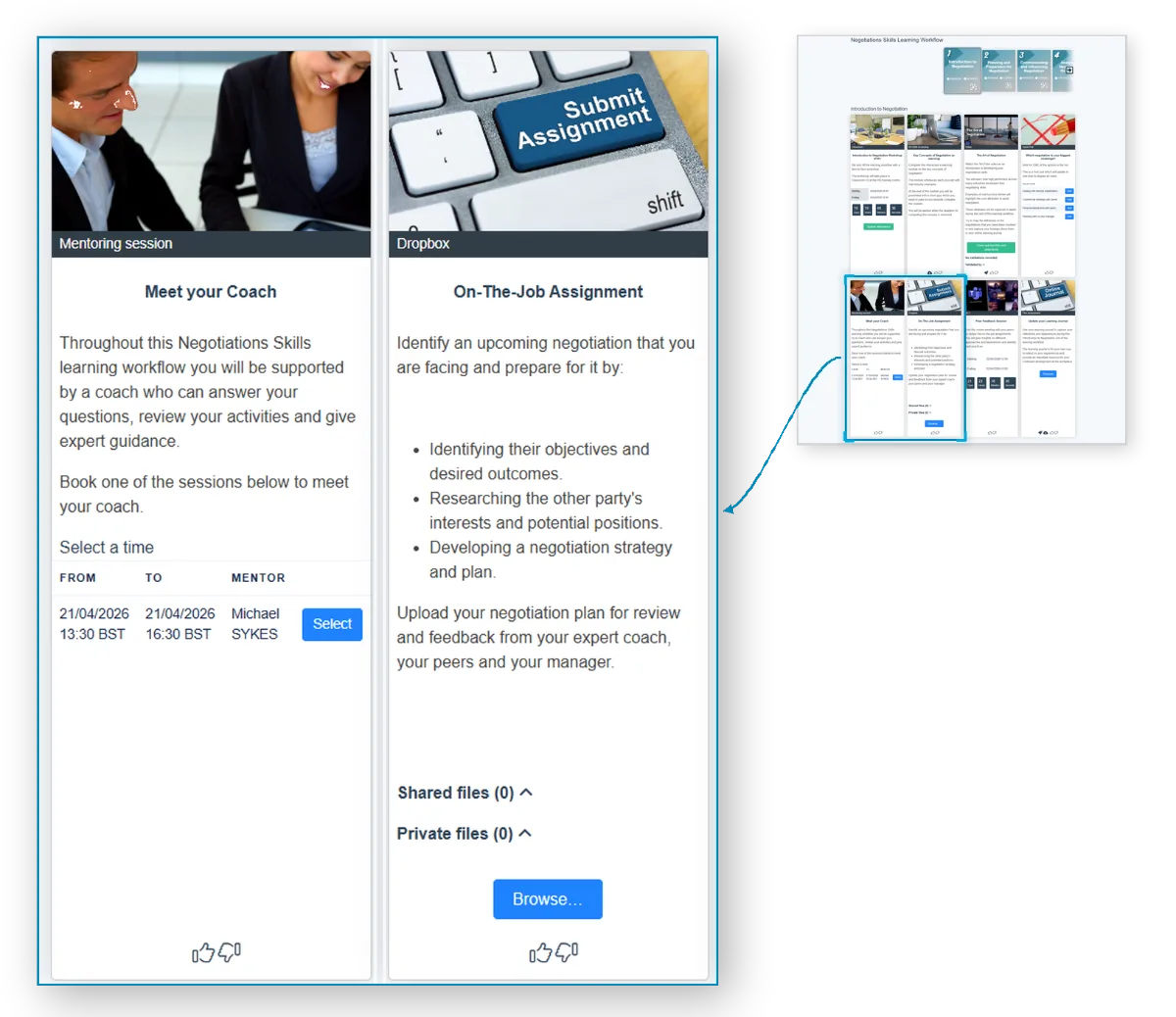
different types of activities relating to the first subject are aligned on a single screen - so the full blend reads at a glance.
Start here: learners click on a subject in the carousel to view all the formal training and performance-based activities for that subject in one screen.
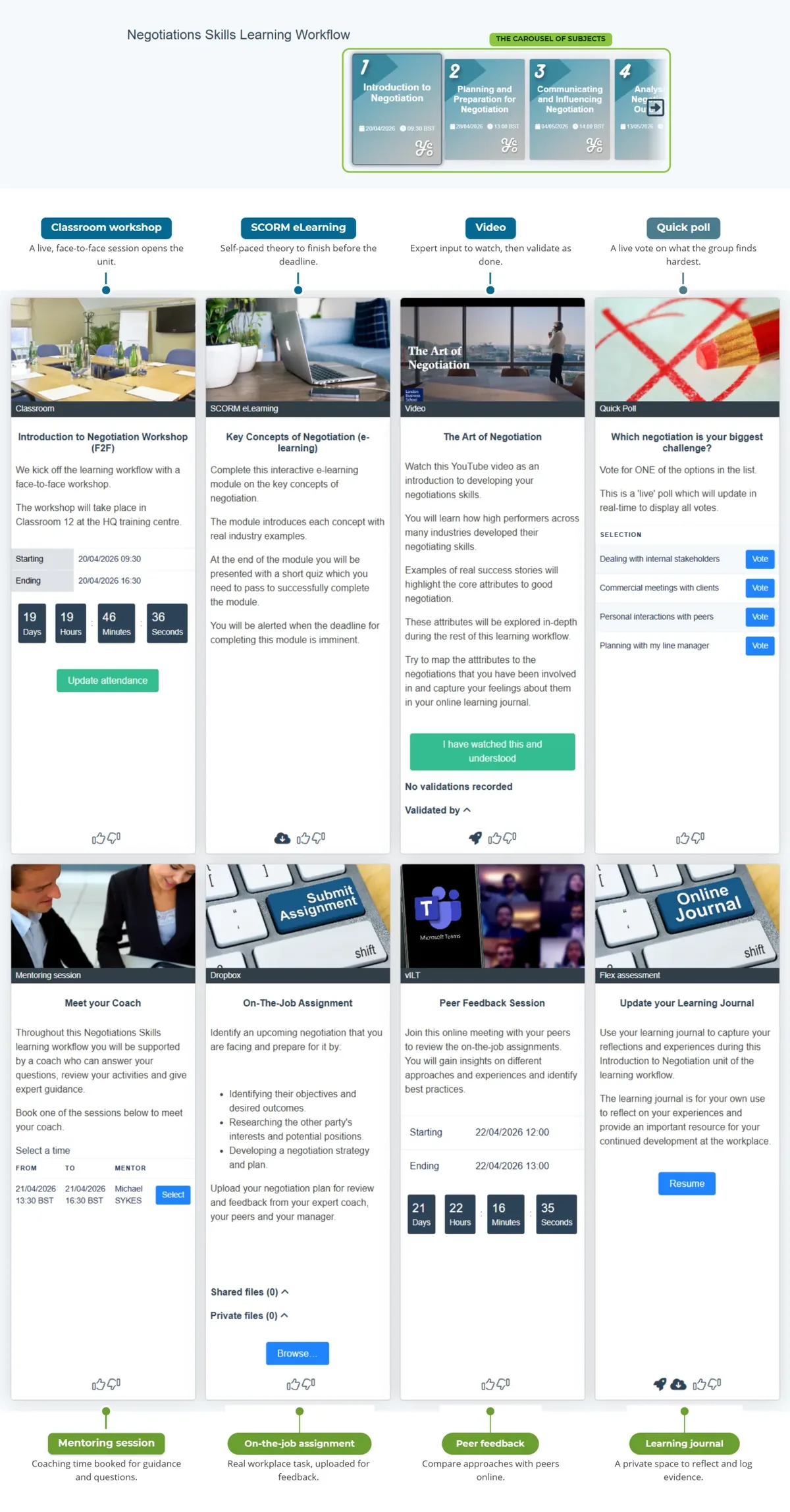
The first subject as the learner sees it, with every activity on one page.
Subject 1
Let's start with the first subject.
Across the top is the formal training: a face-to-face classroom workshop, an e-learning module, a video, and a quick poll. Below it runs a second row of performance-based activities, the tasks that help learners apply the learning back in the workplace: a coaching session, an on-the-job assignment, a peer feedback session, and a reflective journal. Formal training and application activities, organised together in one connected system.
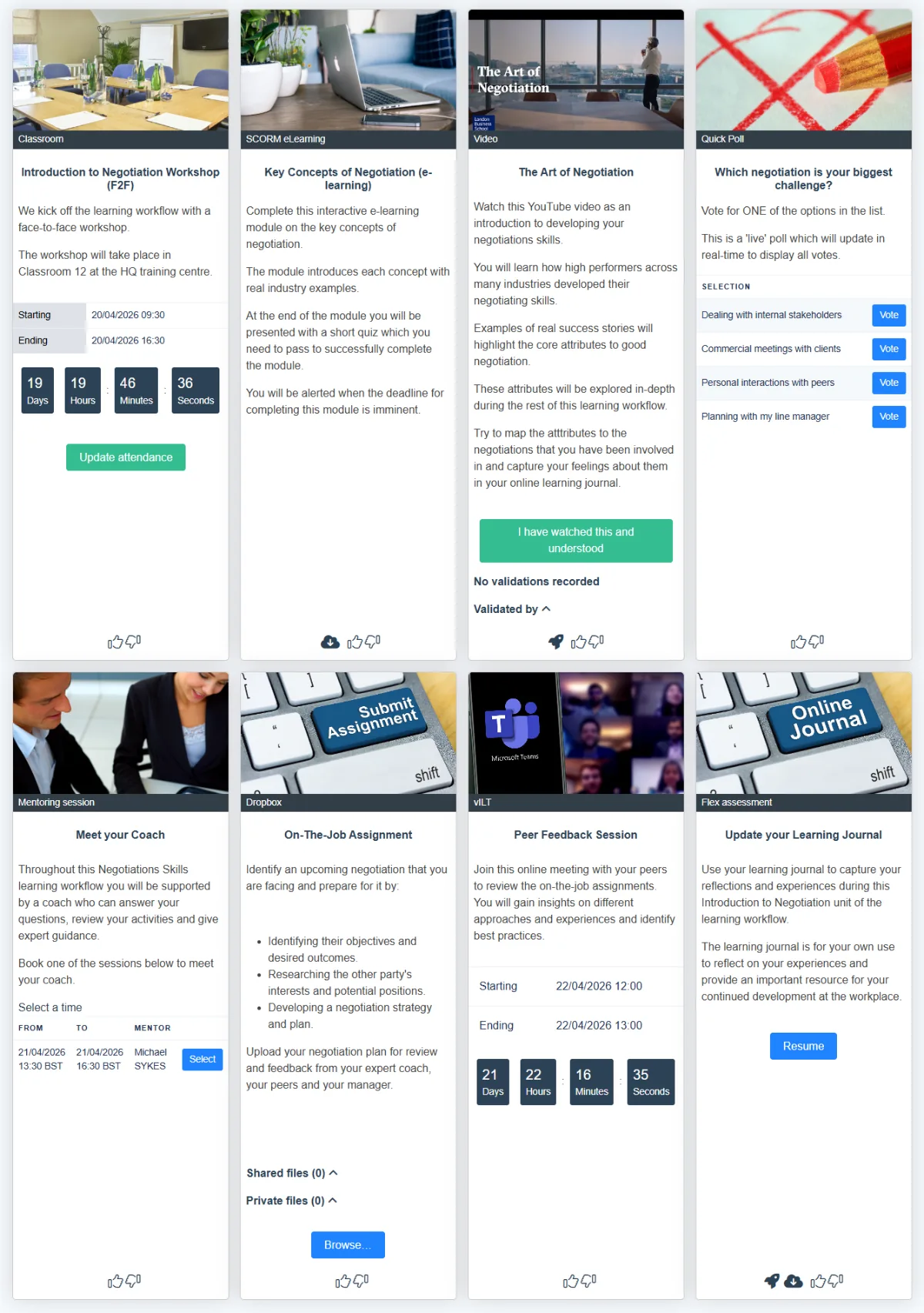
Every activity is interactive, taking the learner directly into a Teams session, playing a video, uploading a file, taking an assessment, whatever that activity calls for.
The text for each activity can be written to maximise the appeal of the activity and sell it to the learner: why it's worth their time.
Let's look at each of those application activities in turn.
Learners select a time to meet with their coach who can answer their questions and help them prepare for the negotiation activities.
A structured assignment to identify an upcoming negotiation and prepare for it using the techniques learned. Clear objectives and desired outcomes guide learners, who must submit evidence of their preparation process.
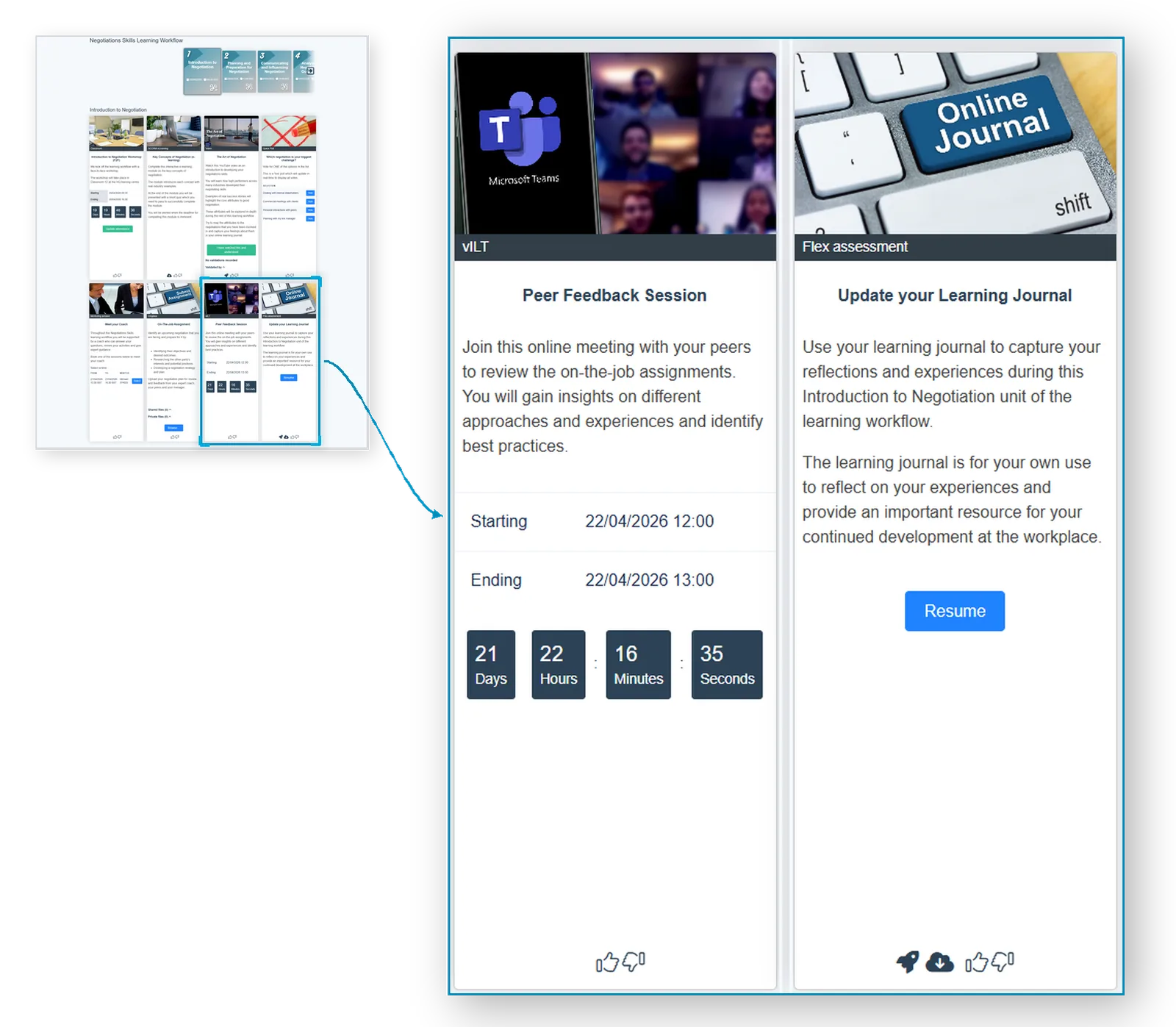
After submitting their assignments, learners join an online meeting with peers to review the on-the-job assignments and gain insights on different approaches. They share experiences and identify best practices.
Alongside these activities, learners update a learning journal. This is an online learning journal where learners capture reflections and experiences. This can be for self-reference or shared with a coach or in a review session with a line manager.
Subject 2
A virtual classroom, a video and an article provide the formal learning activities. Then we look at the performance-based activities being used in this subject.
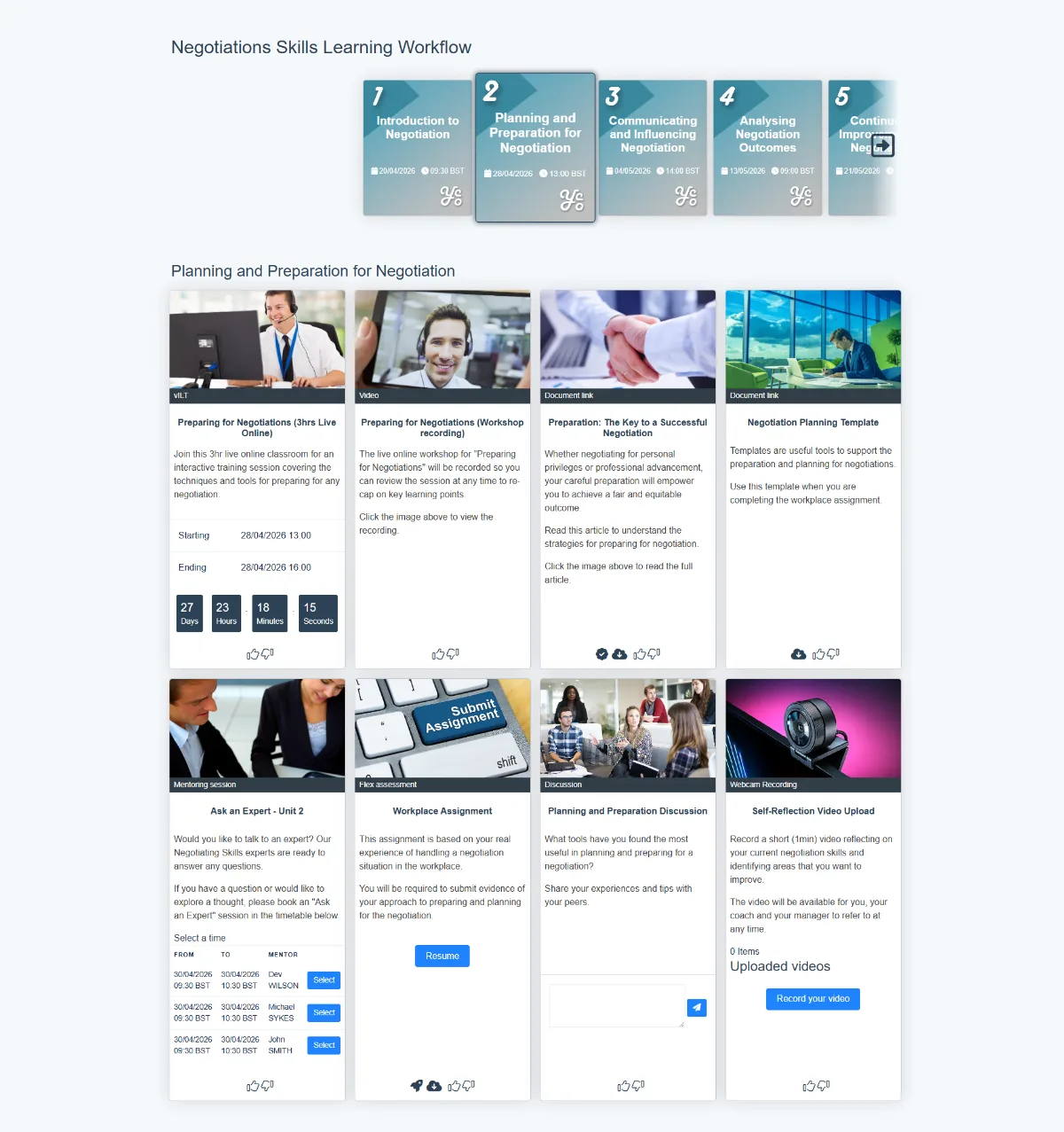
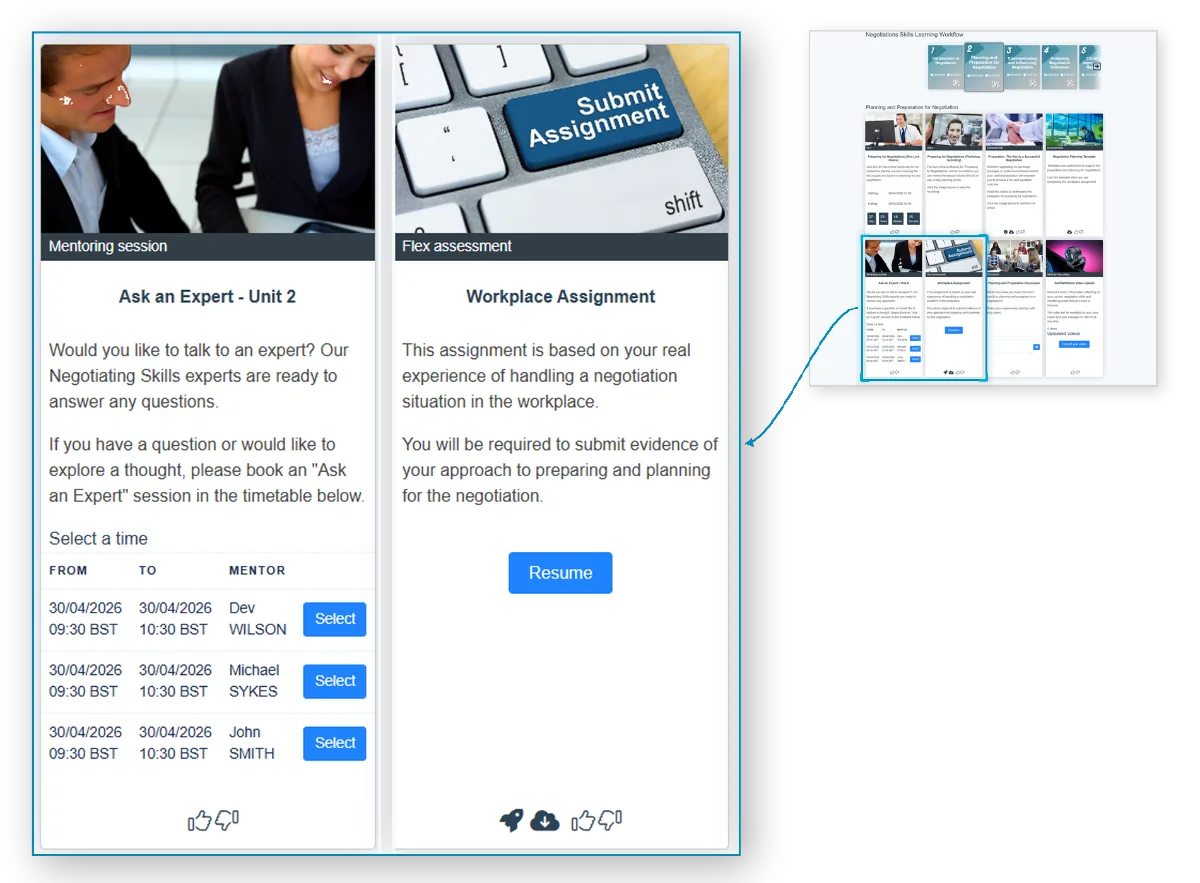
The performance-based activities that help apply the learning are another workplace assignment supported by an Ask-an-Expert feature where the learners can pick the expert they want to speak with and book a session to ask questions about the assignment and clarify their understanding.
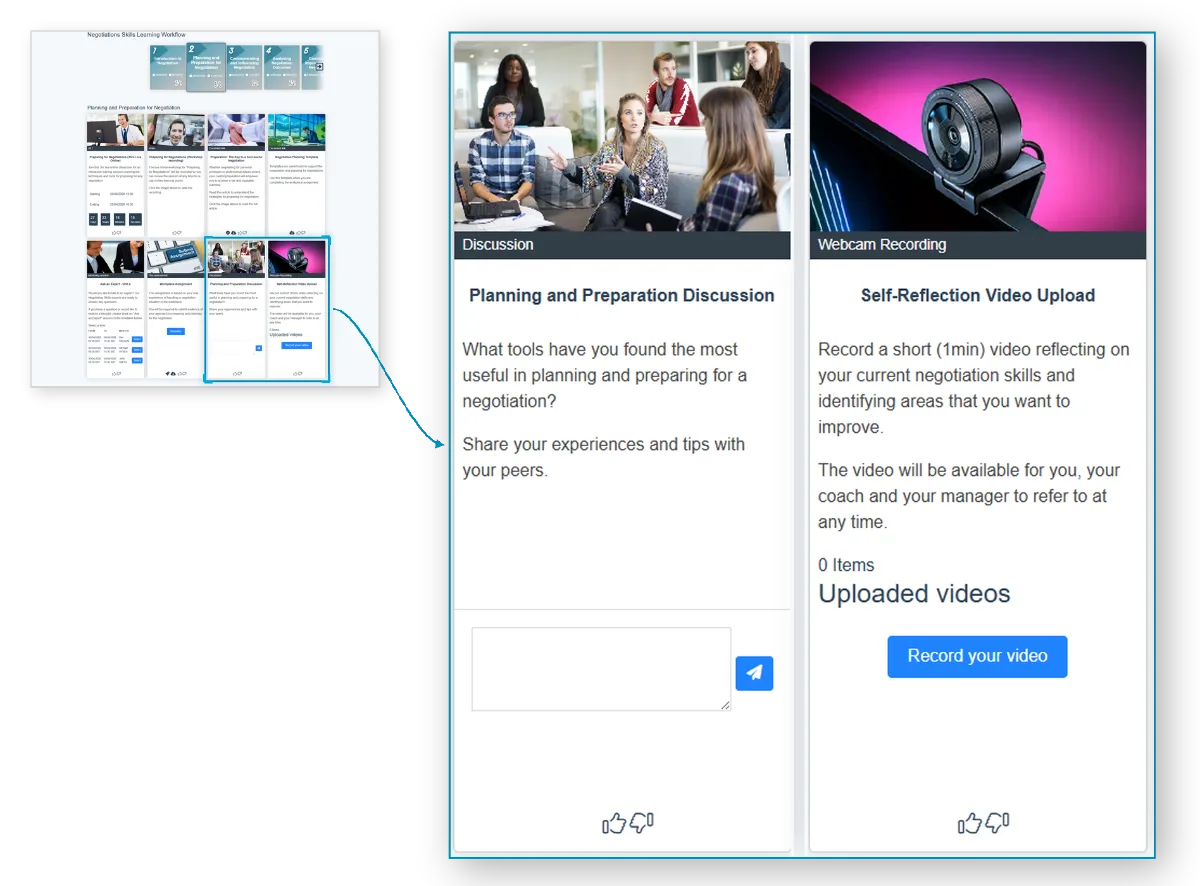
A specific question is posed to the whole group with a discussion board where peers share experiences and answers to that question.
A video upload. Learners record themselves directly to their webcam or smartphone capturing their observations. A live record of their thoughts and insights around this topic.
Subject 3
By the third subject, the pattern is familiar: formal training paired with performance-based activities. The formal training is a live online classroom, an e-learning module, a video and a supporting article. The performance-based activity that defines this subject is a practical role-play assessment.
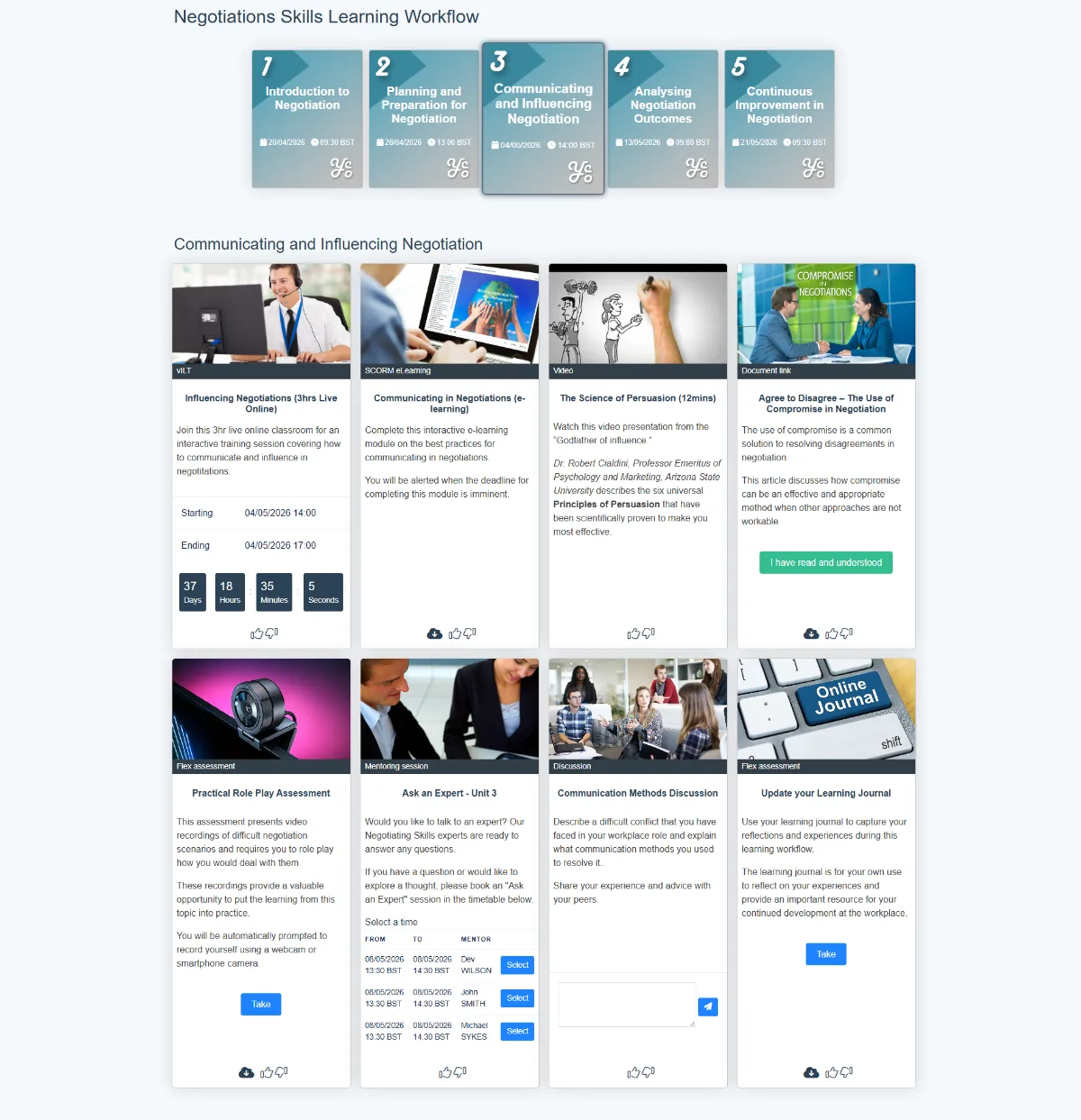
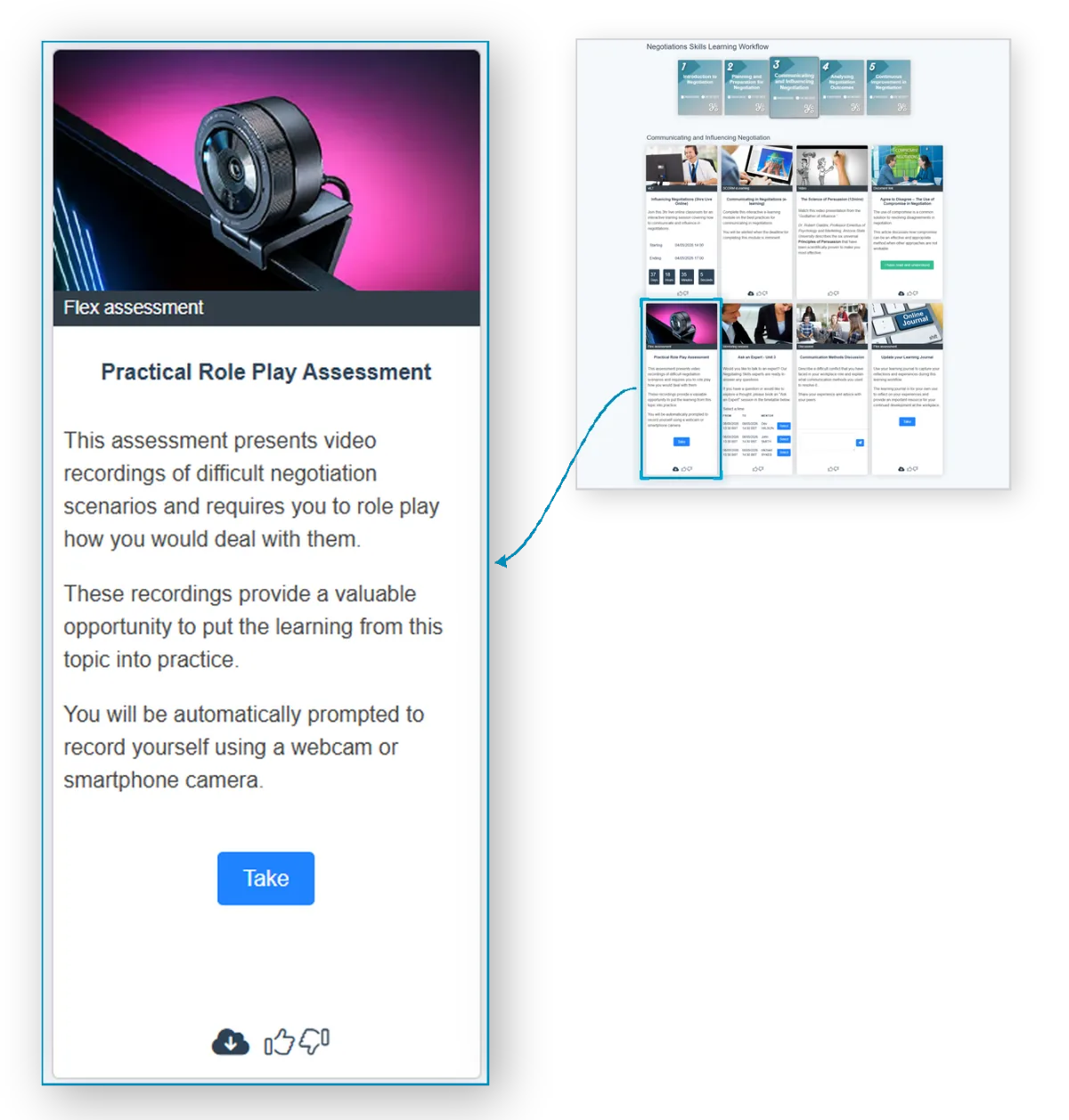
The assessment presents difficult negotiation scenarios and asks learners to role-play how they would handle them.
They are played each scenario and record their responses via webcam or smartphone, demonstrating their performance for review and feedback. A great way to capture real performance on record.
Subject 4
In this subject, the formal learning is supported by a collaborative team project. The performance-based application here is working together as a team on a specified project based on real-world work that they select for themselves.
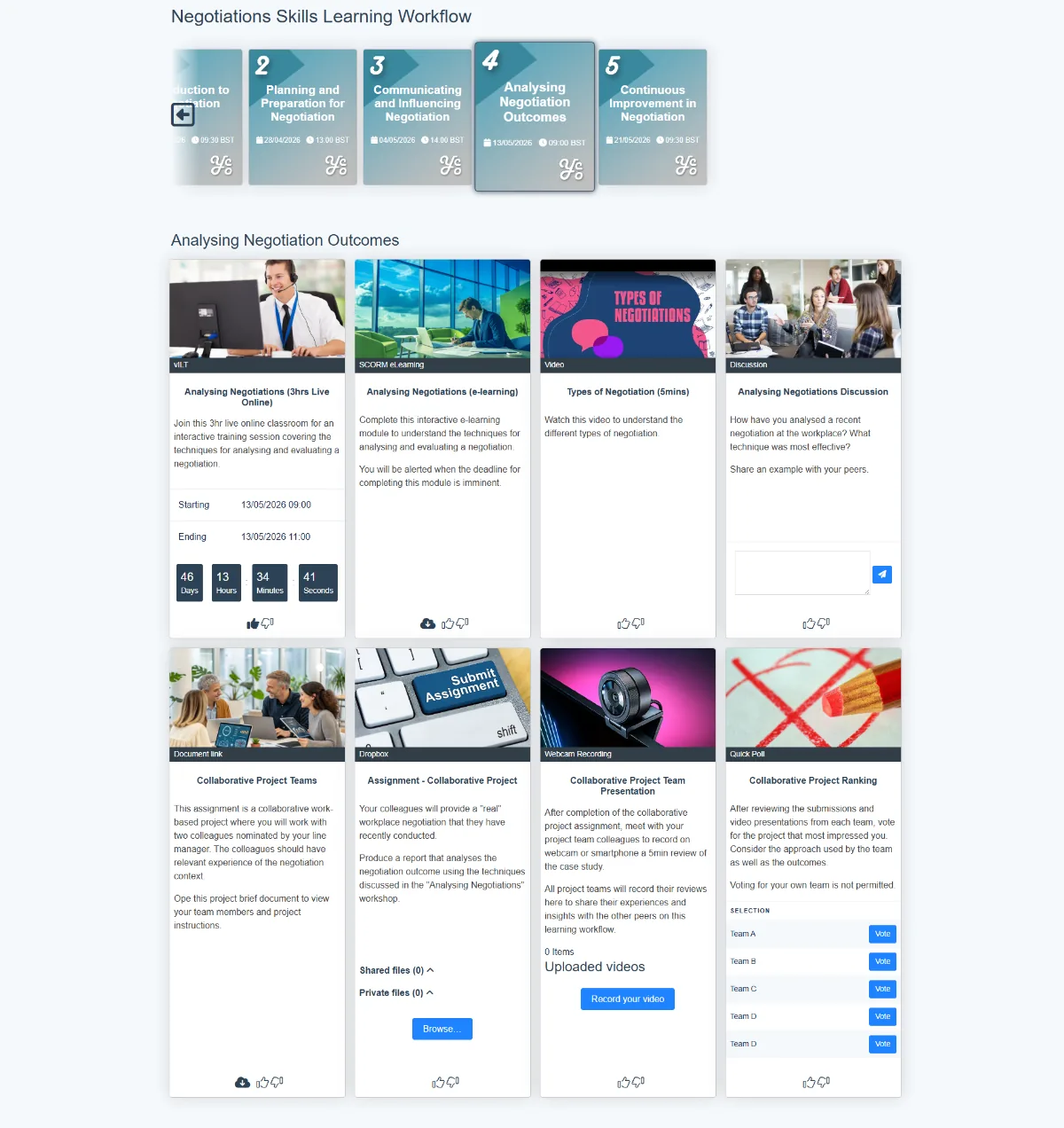
The assignment requires learners to upload and submit evidence of the completed deliverables for that project. They work in teams to create a presentation and record themselves presenting via their webcam.
Each team is asked to rank all the other teams and vote for their favourite presentation and their favourite project. So, we get a crowdsourced, peer-reviewed rating on the quality of the outputs of the work with feedback.
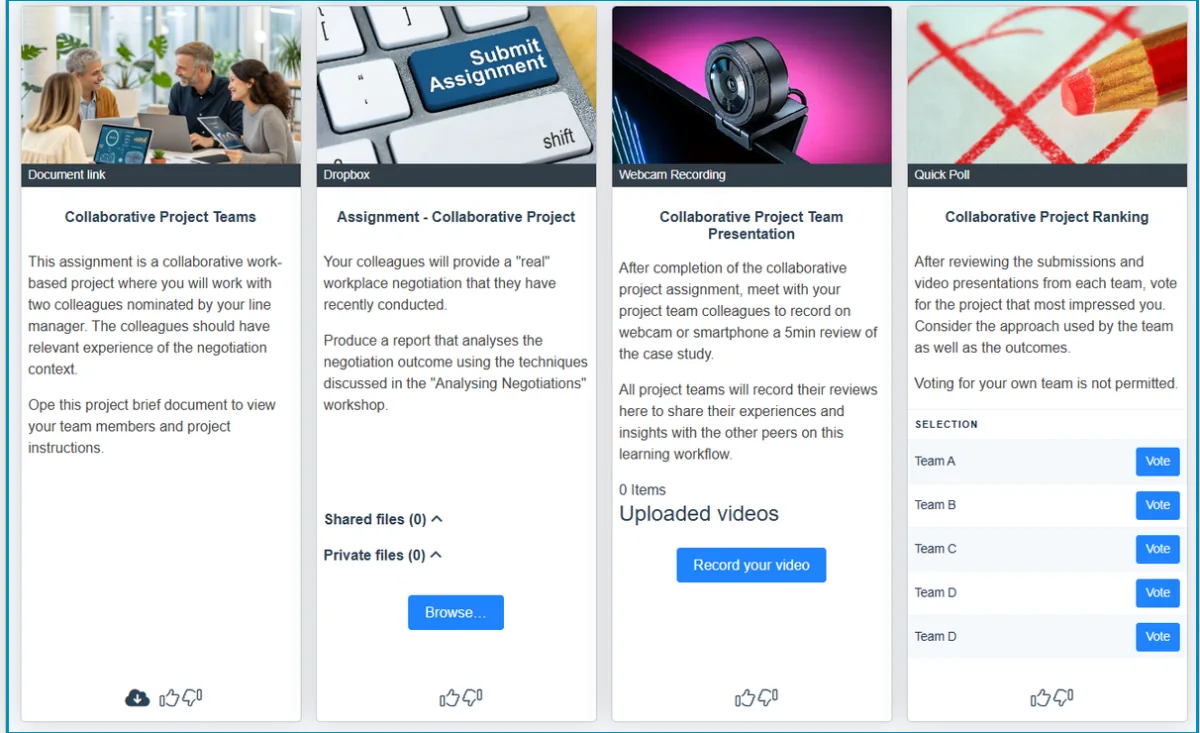
All four activities combine into a single connected collaboration experience:
Subject 5
This closing subject brings the whole workflow together: a final workshop and a resources guide close out the formal learning, a discussion invites learners to name where they still want support, and a closing coach review, a short reflective recording and a learning journal entry capture what they take forward.
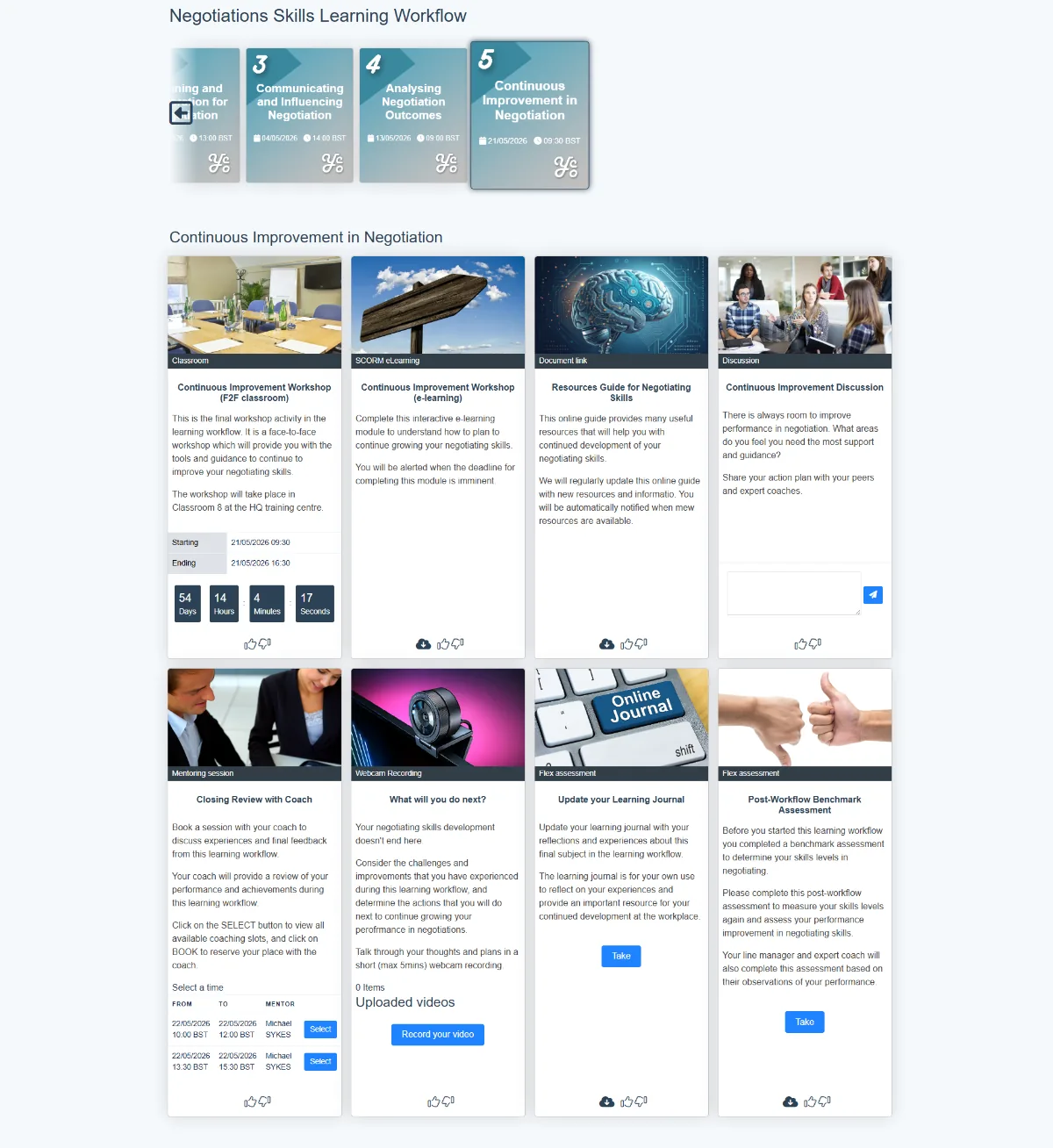
One activity carries the real weight of proof. Let's look at the Post-Workflow Benchmark Assessment.
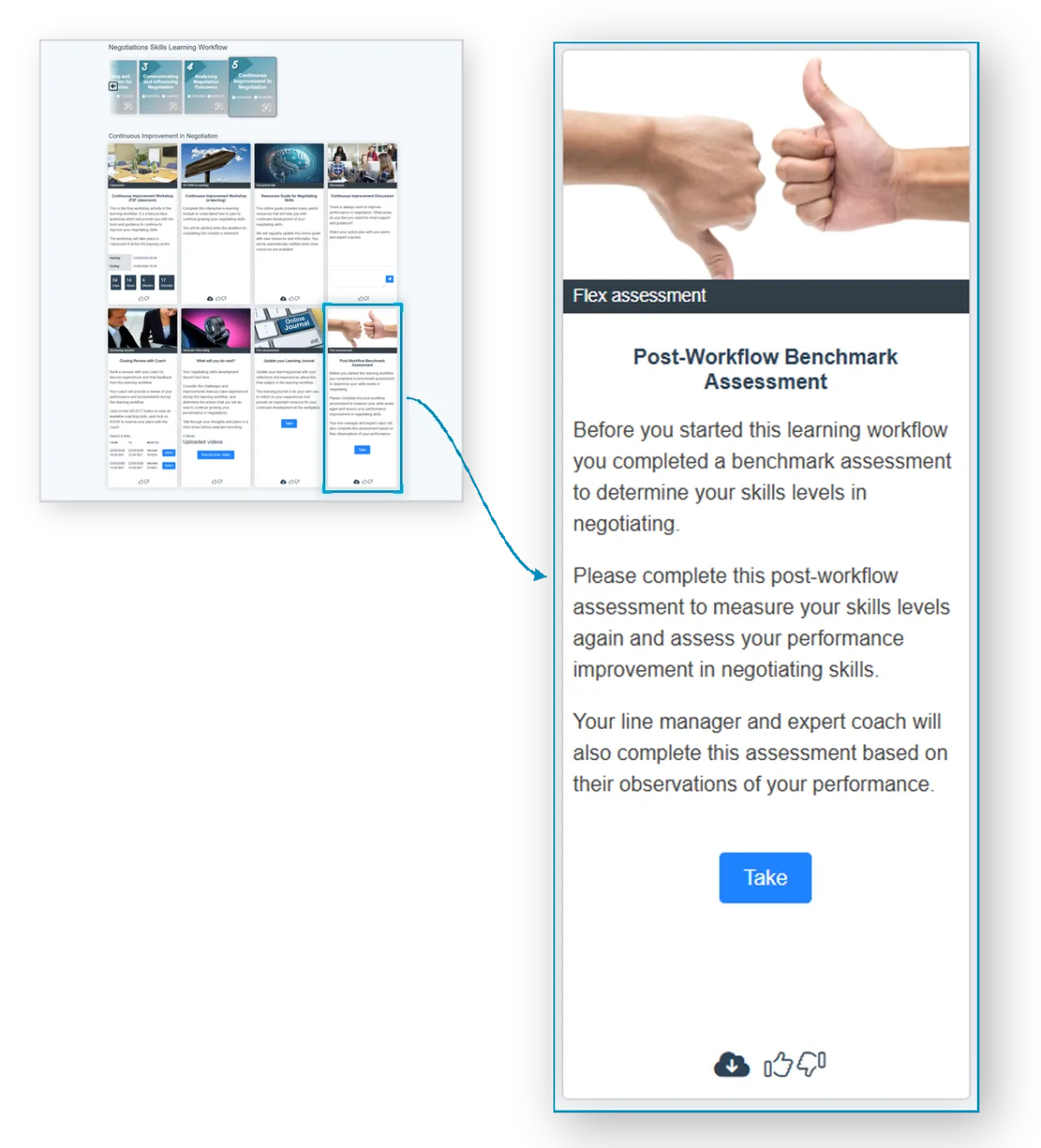
The final subject involves a Benchmark Assessment that measures overall negotiation capability and improvement. This assessment includes:
By comparing these results to a pre-workflow benchmark assessment, we have tangible metrics of performance change and improvement that both individuals and the organisation can use to measure the impact of the learning programme.
What you have seen
Formal training and performance-based activities in one learning workflow:
L&D can demonstrate the value of each intervention with evidence rather than attendance records.
Your LMS handles classrooms and content. It was never built for applying learning.
In summary
By organising formal training and performance-based activities into a single guided workflow, learning extends beyond the training event and into the flow of work, where capability is actually built. Learners stay supported by coaches, peers and managers, and progress is captured as evidence rather than attendance.
The result is a practical way to apply learning where it matters, and to measure the performance change it delivers.
Make the learning stick.