

Leadership Training That Sticks: A Case Study in Flipped Learning for On-the-Job Application
The Knowing Applying Divide
Introduction: The Challenge with "One-and-Done" Leadership Training
Leadership development is one of the most critical investments a company can make. It’s also one of the hardest to get right. For decades, the model has been the intensive, face-to-face workshop. While inspiring, this “one-and-done” event model has a fundamental flaw: without a clear system for application and reinforcement, even the best learning fades the moment leaders return to their busy jobs.
Lysander, a highly respected leadership development consultancy, faced this exact challenge. Their reputation was built on world-class, in-person workshops, but they knew the market was evolving. Clients no longer just wanted a “good course”; they wanted extended and interactive performance-based learning experiences that deliver measurable, lasting behaviour change. Lysander needed to evolve, blending their face-to-face expertise with a digital strategy to drive real-world application.

Take our L&D Performance Scorecard, to assess the gap between Learning Investment and Business Impact in your company.
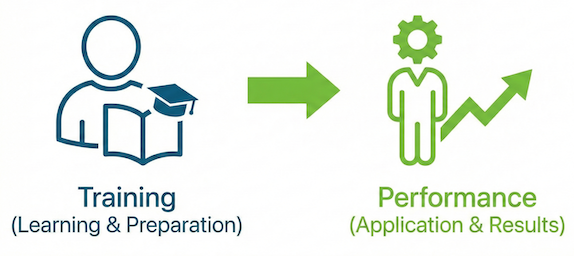
The Challenge: Moving from 'Training' to 'Performance'
Lysander’s core problem was a familiar one. Their workshops were excellent, but they were isolated events. This created three significant challenges:
- Lost Time: Valuable (and expensive) in-person time was being used to deliver foundational knowledge, rather than focusing on practical application and coaching.
- Lack of Preparation: There was no effective way to ensure participants had completed pre-work, meaning workshops often had to cater to the least-prepared person in the room.
- Measuring Impact: Like most L&D programmes, it was difficult to connect the workshop to tangible business results, such as a leader’s improved capability or their team’s performance.
Do you have similar challenges to Lysander? Take our L&D Performance Risk Scorecard assessment to find out where you can improve performance and business outcomes from your L&D provision.
The Solution: A Blended, Automated Leadership Journey
To solve this, Lysander partnered with vLearning Solutions to design a blended learning workflow. The strategy was to use the vLearning platform to automate the entire learning process around a series of core workshops, turning a single event into a continuous development path.
Here’s how they did it:
Step 1: Flipping the Classroom to Maximise In-Person Value
Instead of starting with f2f theory, the journey began online. Lysander used the vLearning platform to present engaging, introductory pre-workshop content. Participants built their foundational knowledge before they attended a workshop.
The result: The face-to-face workshop was completely transformed. It was no longer a lecture; it became a high-impact session focused purely on application, strategic discussion, and deep coaching—things that can only happen in person.
Step 2: Using Automation to Drive Accountability
A “flipped classroom” only works if people do the pre-work. Lysander used the platform’s accountability and monitoring tools to track completion automatically.
This simple feature was a game-changer. Automated reminders ensured participants were prepared, and facilitators could see at a glance who was ready. This single step maximised the effectiveness of the workshop for everyone.
Step 3: Measuring Capability, Not Just Completion
The journey didn’t end when the workshop did. Lysander used the platform’s analytics to track engagement and measure outcomes long-term.
They could see how participants interacted with follow-up materials and, most importantly, gauge actual capability improvements back in the workplace. This moved their reporting from “did they attend?” to “did their behaviour change?”
Take our L&D Performance Scorecard, to assess the gap between Learning Investment and Business Impact in your company.
The Results: From 'Happy Sheets' to Hard Business Metrics
By shifting to this automated, blended model, Lysander achieved a measurable business impact that “one-and-done” training simply cannot.
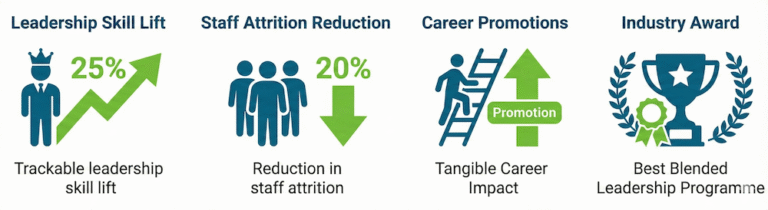
- Measurable Skill Lift: The programme delivered a 25% increase in leadership skills, measured directly through capability analytics.
- Massive Reduction in Attrition: Companies that put their leaders through this programme saw, on average, a 20% reduction in staff attrition—a huge, bottom-line saving.
- Tangible Career Impact: Participants were highly sought after within their own organisations, with many gaining promotions as a direct result of their new, demonstrable skills.
- Industry-Wide Recognition: The programme’s success was validated externally, receiving an industry award for the best blended leadership programme.
- Commercial Growth: The high demand for this new, results-proven model led to significant growth in new client business for Lysander.
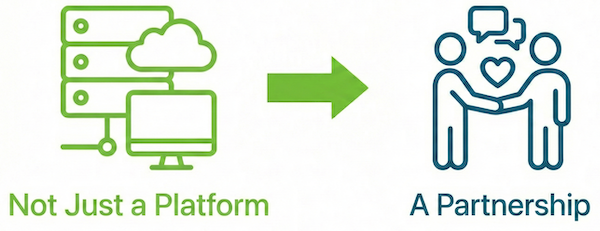
Why It Worked: A Partnership, Not Just a Platform
This success was built on a collaborative partnership. As Lysander’s team notes, the vLearning platform was only part of the equation; the relationship was the key.
“vLearning has been a great partner – from their openness to collaborate, responsiveness when we’ve got a need with a client, to progressiveness with wanting to develop a better product and take onboard our thoughts, suggestions and feedback.” Kerrie Adaway, CEO
Want to make similar positive changes to those seen at Lysander? Identify the gaps between Learning Investment and Business Impact in your company, with our L&D Performance Risk Scorecard.
Conclusion: Stop Delivering Events, Start Building Journeys
Lysander’s story provides a clear blueprint for the future of leadership development. By automating the journey, flipping the classroom, and focusing relentlessly on measuring application, they proved that leadership training can (and should) be directly linked to business performance. They moved beyond the “one-and-done” event and created a system that guarantees training sticks.
L&D Performance Risk Scorecard
Evaluate your current approach against five dimensions that determine whether training produces measurable performance improvement—or disappears into the knowing-applying gap.
Share this Article
X
LinkedIn
Related Resources
